AI and Language Access in Healthcare: Communication Equity and Patient Safety
with Carol Velandia
Carol Velandia, Founder of Equal Access Language Services, brings a deeply practical perspective on where AI falls short in healthcare: language access. She explores why machine translation and AI-driven interpretation tools cannot capture the cultural nuance, emotional context, and clinical precisi...
Show Notes
AI in healthcare cannot replace language access, and treating it like it can puts patients at risk. Carol Velandia, Founder of Equal Access Language Services, has built her career around eliminating language-based discrimination in clinical settings. Her core argument is direct: you cannot outsource ethics to AI, and the companies that win will combine AI speed with human-in-the-loop precision.
What We Cover
- Why language access is patient safety infrastructure, not an administrative convenience, for the 26 million Limited English Proficient patients in the US.
- Research from the Agency for Healthcare Research and Quality showing LEP patients experience 4 times more severe temporary harm than English speakers.
- What the Affordable Care Act Section 1557 requires and where AI-only translation falls short of compliance.
- Why cultural context around health, illness, and family dynamics cannot be replicated by current machine translation.
- How AI with human post-editing can expand access without eroding the clinical precision that patient safety demands.
Key Takeaways
Language access is infrastructure, not a service line item. Declaring English the standard in a clinical setting is, in Carol's metaphor, like declaring staircases the standard. There is nothing wrong with staircases unless you use a wheelchair.
Machine translation accelerates speed, not accuracy. A word with specific clinical meaning in one language may not translate precisely into another. Human post-editing is what keeps translation safe in diagnosis and treatment planning.
Ethics cannot be outsourced to AI. Reducing language access to a cost-reduction problem rations care based on budget rather than patient need, which is the opposite of the equity healthcare leaders claim to protect.
Frameworks & Tools Mentioned
- Affordable Care Act Section 1557
- Agency for Healthcare Research and Quality (AHRQ) research on LEP outcomes
- Effective Inclusion Through Language Access training course
- Human-in-the-loop translation models
Chapters
- 00:00 – Language access as ramps vs staircases
- 00:45 – Why this matters in an AI era
- 03:10 – Trust, readiness, and frontline communication
- 05:10 – Communication is the most powerful diagnostic tool
- 08:20 – Civil rights, policy risk, and meaningful access
- 12:10 – AI won’t replace ethics, empathy, or rapport
- 15:00 – Human-in-the-loop translation and post-editing
- 17:40 – Artificial intelligence is not moral intelligence
- 21:45 – Inclusion as infrastructure, not an afterthought
- 24:10 – Making language access visible as patient safety
- 26:20 – “Language access is the bridge between compliance and compassion”
- 27:55 – How to reach Carol and learn more
About Carol Velandia
Carol Velandia is the Founder of Equal Access Language Services. She trains healthcare providers on communication equity, Section 1557 compliance, and the cultural frameworks that determine whether a patient can safely describe their symptoms. Her work sits at the intersection of patient safety, equity, and responsible AI deployment.
Related Resources
Related episodes:
- AI in the ER: Clinical Judgment at the Bedside
- Balancing Human Judgment and Clinical Trust
- Healthcare Leadership and Operational Reality
From The AI Health Pulse:
Related topic: Clinical AI and Patient Care
Related article: Healthcare Data Strategy
Carol Velandia Shorts
Short clips featuring Carol Velandia from this Signal Room episode.
Guest

▶ Full Episode Transcript ~4,801 words
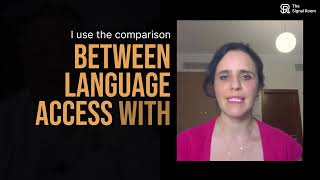
Carol Velandia: Knowing when and how to use professional language services, for example. Because in reality, if you think about communication, that's the most important and powerful diagnostic. So I use the comparison between language access with a ramp. I make the distinction between ramp and staircases. When we are told the official language of the US is English, there is nothing essentially wrong with that, right? It's like saying staircases are not wrong, right? But if you have a wheelchair, then you have an issue with just the staircases. I use that comparison because it makes inequity visible.
Chris Hutchins: Carol, welcome to the Signal Room. I'm so excited to have you here. Just as exciting. We're in a really exciting but a little scary time with artificial intelligence. I recall back in the early 90s how excited everyone was when we all of a sudden started to have this internet thing. And now I don't know what it would be like without it. Even since then, we now have cell phone technology, and now AI is this whole other universe that seems to have like limitless potential, but at the same time, there's a lot to be concerned about. I think my initial conversation with you, I started to understand a little bit about what you do. And I saw there's a real need for people like you to keep us grounded, making sure we're doing things that keep us human and not losing sight of what human beings need. Maybe you could tell us a little about your company, Equal Access Language Services. It has a lot of implications just in the name, which I think is wonderful. Maybe you could tell us about the organization, what you do, and what inspired you to start the company.
Carol Velandia: Thank you, Chris. Since you were infused in our interaction, we've always been worried about oh my God, are we humans going to be replaced by technology? That happens also in the language industry when we thought that maybe translators were going to be replaced by machine translation. And it's been around for decades, yet it hasn't replaced human translators. What it has done is that it has enhanced all those capabilities. My company, Equal Access Language Services, is about eliminating language-based discrimination and to help people understand that AI will never replace ethics, care, empathy, or rapport. But we definitely want AI to be a part of our evolution and enhance access. My company does provide language access training to healthcare providers. We want to make sure that everybody, from the front desk person to management to leadership, understand the impact of language in healthcare. I educate professionals in this. That's the part that makes my company very different from other language services providers. In addition to that, we offer language services like interpretation, translation.
Chris Hutchins: It's interesting because when it's organization, think about access. There's so many different facets to it. That's the stuff that's really being discussed for the most part, at least across the US, I suspect is similar in other places because there's definitely shortages of nursing, shortages in clinical care for some specialties, and increasingly more need from general practitioners. Capacity is all obviously a challenge, but we're also in a global community, the world is not as big as we once felt like it was. There's a lot of need almost in any place you go for a really diverse array of services, making sure that it's accessible from a language standpoint, not only the cultural things that drive people's decision making about their care, but the simplest of things, just being able to communicate and understand another human being. It's something that I don't think gets enough attention. So I'm really excited about what you're doing. This conversation is one I've been really looking forward to. We're talking about things that are core and basic that human beings need. We cannot lose sight of the core needs of a human being. The very first thing is can I understand what somebody's saying to me? Can they understand me? It's really core and it's got to be front and center in anything we're doing from a development standpoint.
Carol Velandia: I think a lot about it.
Chris Hutchins: Let's talk about the transformation we're entering into. I think about it in terms of workforce readiness. Trust's probably one of the bigger factors. I'd love to get your take on how do you really address the trust factor? We're at a point in time when trust has eroded over the last couple of decades. From your standpoint, what are some of the core things we need to make sure that our clinicians, our nurses, our medical assistants, our frontline staff interacting with patients, what are some of the core things they really need to have and that we need to be thinking about helping them to be proficient to meet the challenge?
Carol Velandia: I talk about a call communication equity, right? Because I think every provider must develop those core skills that you talk about, right? And specifically in my case, I talk about language access skills. And this include language awareness, interpreter ethics, knowing when and how to use professional language services, for example. Because in reality, if you think about communication, that's the most important and powerful diagnostic tool. So when we think about that, let's let that sink in for a minute. Communication is the most important diagnostic tool. That's when there are threats to that. If that tool is compromised by language barriers, every other aspect of care will fail or be compromised from diagnosis to discharge. So everything will become less effective and also more expensive. And I think this is where we make mistakes because we associate language access services with an administrative thing, almost a burden. But what I want to say is that they are absolutely key for patient safety. There are tons of studies demonstrating that language barriers impact beyond what we think about. For example, there is less compliance from the patient perspective when there are communication errors, right? And this will influence the trust in the doctor. I want people to think about the rapport they create with the patient, how important that is, and how the interaction is a foundation for healing. That's what language access is coming to provide enhancement to your relationship with the limited English proficient population, which is a huge portion of our US population. About 26 million people in the US don't speak English. And all of them, every single one of them, will have medical encounter at some point in their lives. So we have to think about effective communication and inclusion through language access. Discuss more about it.
Chris Hutchins: When we think about some of the recent changes in legislation, we've talked about the recent executive order intended to officially say English is the language in the United States. There's some debate around how far that should go. Legislation doesn't necessarily change human behavior and it doesn't affect what human beings need. Talk to us about your perspective as someone trying to improve access and understands that language is at the core of what's going to help people have access and get to that trusted relationship with their physician. They can't understand how they even get started and have a relationship.
Carol Velandia: You mentioned several things. One is the access part, right? I use the comparison between language access with a ramp, and I make the distinction between ramp and staircases. So you mentioned the changes in policy, right? When we are told the official language of the US is English, there is nothing essentially wrong with that. It's like saying staircases are not wrong. But if you have a wheelchair, then you have an issue with just the staircases. It's the same way. We say the official language of the US is English. And in addition to that, they repeal the new executive order that talked about meaningful access and language access for those who have language barriers, then it becomes a real problem, right? I use that comparison because it makes inequity visible, like when we compare a ramp with a staircase. If we replace wheelchair ramps with stairs, everyone would recognize that as discrimination. Yet when we make English the only language of care, we don't see the same thing. When a patient walks into a hospital and can't understand the forms, the consent process, or the discharge instructions, they're not being given the same access to care as others, right? It's like asking them to climb invisible stairs. For those 26 million people in the US who are limited English proficient, that is a very steep staircase, is exhausting and sometimes it will threaten their lives. I want that to be very clear. Another interesting thing that happened to me when I read the Executive Order 14224, which is the one that talks about English as the official language, I realized how executive orders are useless when it comes to protect civil rights. Even one signature, though that the civil right of language accessibility, which is a civil right protected under Title VI, in jeopardy, it made me think that civil rights need to be protected by actual laws. Just like the Americans with Disabilities Act is protected, is passed through Congress. We should be able to protect communication in general. Whether you are a deaf, deaf, blind, or hard of hearing person, or if you don't speak English, you should be protected the same way. And we are not. So I think that we need to emphasize the importance of changing policies at that level. We don't excellent point.
Chris Hutchins: Oftentimes we don't necessarily think about some of the more foundational aspects of what it's like to be a human being when it comes to how we are providing care. When you talk about health care, we're forgetting the most core thing, and it's right in the term health care. We can't claim to care and take care of people if we don't first try to understand them and start to get an understanding of what they need.
Carol Velandia: AI is not going to protect your dignity. Human will is nothing against AI. Where do the capabilities of AI start and end? And when do the human capabilities are better utilized? Like when do you really need a human brain to provide dignity?
Chris Hutchins: That's one of the things that we've got to figure out is where does AI work? We know there's a fear out there. Is AI going to take my job? It's a challenge for people who do translation and interpretation for a living. They have concerns about that. Talk about where you see the risks and what should we be looking at in terms of guiding principles to help us make sure that we're using it as a tool to enhance and empower people to operate at the highest level of their licensure, as opposed to just rip and replace. We obviously cannot replace human beings with machinery or technology.
Carol Velandia: Yeah, addressing your question at the beginning, you said that many people in the language services industry are afraid because AI represents a big threat. And I agree that there is a sense of doom in the language services side, except we have come to realize that only those that don't know how to use AI probably will be left without a job. But I will go even further and say that this is the precise moment when we need to emphasize ethics and ethical behavior, not only from interpreters. I teach ethics to interpreters. My colleagues were very worried about the perfect word and the exact word. And that's actually the thing that AI might replace. Is you know if you don't know about a word, you have your phone and you know exactly where to look for the perfect word. But it's your brain and your heart and your cultural norms that are going to give you the ethics aspect, right? It's not AI. You can't outsource ethics to AI. And this is why I emphasize on that, not only for interpreters, for physicians as well, for nurses, for social workers. I actually became very familiar with every single one of the codes of ethics to incorporate them in the training effective inclusion through language access, which is a training for healthcare professionals that underscores the mandate they have: nurses, social workers, doctors, medical doctors, pharmacists, dentists, and also lawyers, right? I read all of these six codes of ethics, and they all have a mandate on communication and effective communication with the community that they serve. We have already hinted at the fact that effective communication could be a combination between AI and humans, right? Ethical communication, and you can't offer effective communication to your community unless you include, as part of your community, all of those who don't speak the language, the 9% of the population in the United States. That framework of language access as a civil right is what is going to help you as a professional really deliver safe care on the language.
Chris Hutchins: This is absolutely around what AI shouldn't do. From your perspective, how do you see AI really being useful? You mentioned a really important point. AI isn't going to replace people, but it might replace roles where people are not learning how to employ and use AI to help them in the work that they do. So, what are some of the things that you think it could be useful for people that are currently doing interpretation and translation?
Carol Velandia: Yes, so AI is already very useful because it's going to expand access, it's going to make it faster. We can produce a translation of thousands of words very quickly, but you still need to review that translation. Companies that combine AI with human-in-the-loop approaches are going to excel, in my opinion. AI is going to make things faster, right? Not necessarily accurate. This is when humans come, right? And when but when you combine the two, then you can offer faster services, broader range of languages, perhaps, broader range of services as well. But always keeping the human perspective. For example, I educate my own clients, I talk to them about AI, how that will reduce the cost of translation, because I will use post-editing. The human is going to compare the translation, and it has been proven to be useful. To give you a recent example, the word safety in English, and my client had the word safe and then slash the T. The use of that acronym in English makes perfect sense. We translated it using AI. The AI translated it literally, and it made no sense. So T for safety, or I'm sorry, T for turning into action, for example. It wouldn't translate the same. You need a human to find the most creative solution in that particular point. Still, we powered the translation with AI, but we used the human for the post-editing to make sure that the client was actually conveying to the Spanish-speaking audience the same thing, not something that sounded like a machine. And that's important. I'm giving you one example of how we can use the AI and still use humans in the loop, which is what I had okay. For safety, this is very important, specifically in healthcare. Humans provide that safety point and compliance.
Chris Hutchins: I think it's important. And one of the things I've been wrestling with myself as a data person is how do I help organizations identify places where we can use it? There's going to be a lot of attention from a legal and compliance standpoint, risk management. Thank God for people who are trained and proficient in those areas, they're going to help to keep us from missteps. But at the same time, we don't want to be paralyzed because we're afraid we're going to do the wrong thing. We have to find ways that we can actually deploy it where it can enhance safety. We want to be looking for those kinds of opportunities.
Carol Velandia: Yes, really emphasizing that artificial intelligence is not moral intelligence. As far as I understand, artificial intelligence doesn't have a conscience yet, but humans do. So I believe in a partnership with AI, not in a replacement of humans. On that note, I think it's very important to emphasize that we as humans have to continue to see the ethical aspect of care always. And also think of the type of standards that we would apply to ourselves. For example, many people in the AI front think that all translations are going to be replaced by AI. And I always ask them, and I have had at least six informal interviews with tech people or medical tech people. And I asked them if you are in a country where nobody speaks your language and you get sick and go to the doctor, would you feel okay if somebody comes with a tablet telling you your diagnosis, prognosis, and treatment? And that all has been translated by a machine and you only see the tablet, would that feel okay with you? And the six persons told me, actually, no, I would prefer a doctor to tell me, right? So even with an interpreter. So I'm saying, okay, if that is the standard you want for yourself, what makes you think that the other person is going to want a lesser standard? That's a great point.
Chris Hutchins: I remember the first time I called a support line for a computer I was having difficulty with. And I got a machine on the other end. It was very frustrating. The models were looking at decision trees where my answer would trigger one of two options and go through a sequence. It was trying to guide me through what it thought I wanted to have to talk about. And there was really a very, it was almost impossible to get it to skip over things to get to where you want to do the critical thing we need to understand is in healthcare, it's much more important than when you're just calling to get support for your computer. How a person communicates and what they need in that moment is even more intense and necessary than a support call for the computer.
Carol Velandia: In healthcare is really a matter of life and death. There are examples of how the limited English proficient population experience four times more errors that could change their health and their life. Like they are called severe temporary errors. The Agency for Healthcare Research and Quality published a study in 2012 that talked exactly about this. Limited English proficient are four times more likely to experience severe temporary harm than English speakers. If that doesn't show you the importance of the language barrier, nothing else will, right? In healthcare is particularly important. There are several studies that I quote all the time in my trainings about why language accessibility is not just a nice thing to have, it's a safety task. And I think that we need to have that perspective before we even implement anything in healthcare. What I find in my work is that perspective is still fuzzy. We still see healthcare providers solving language barriers in any which way, using children and trained interpreters. I recently saw an attorney, but I'm telling you, three weeks ago, I saw an attorney who wanted to discuss the terms of a plea deal with her client. Just imagine if that was your case. You're, I don't know, some country that's not necessarily friendly. Or forget the friendliness, but you don't speak far. And you make a mistake. You're not even aware that culturally you couldn't make that mistake. You're now in court and somebody's trying to tell you what you are about to face with Google Translate. Would that make you feel like, oh yeah, okay, I can go with this? No, you probably are gonna be like, Can someone explain to me?
Chris Hutchins: We're coming up on time, but I want to touch on something. There's been a lot of conversation. And different perspectives on what we were calling diversity, equity, and inclusion. You've talked about inclusion as infrastructure. I think that's a really important thing for us to be thinking about as we're designing. What do you think it means to design language access into systems rather than adding it later? This is something that we've got to build in from the very foundation. Talk to me a little bit about what that looks like from your perspective. How do we make sure that's where we take this as we're developing?
Carol Velandia: Yes, I think that's such an important point you make, Chris, about changing something into an infrastructure, not just a nice to have diversity, equity, and inclusion is a good example because we really haven't come up with many ways to measure success in that front, other than numbers of people of this race or that race or this gender. But in terms of outcomes, I think we are lacking. When we include language access, we can measure healthcare outcomes between people that had medical encounters with professional interpreters versus people that had a medical encounter with no interpreter or with an ad hoc interpreter. The literature is there. The ones that made much fewer mistakes were the professional interpreters. That is what I mean by turning this into an infrastructure. Language access has to be part of your planning, your strategic planning. It has to be aligned from the beginning, not just as an afterthought. There is always no budget for language access. In some major hospitals, there is and has been for a very long time, but some institutions think that because they are smaller or because they are nonprofit, they have an excuse to not have a plan for language access. Really, we don't have an excuse. Just the same way as we have to provide ramps for people with wheelchairs. We have to incorporate language access. So that's what I mean by making it part of the system. When you think about communication harm, it causes the same kind of harm as medication errors or surgical mistakes, right? Sometimes it's even worse because they sometimes go unnoticed. And I think this is part of the problem of language access. We need to make them visible. To give you an example, when I worked for a hospital, one of the major hospitals in the US, which was an honor to me to have worked there. But I remember having the conversation with my manager about moving language access, our department in language access services, into patient safety, because that hospital actually had a complete department of patient safety. And they were under an administrative side. And I'm like, this is a clinical issue, it's not only administrative. So anyway, I created a video called Saving Lives in Many Languages. There was a contest on patient safety, and I would like to share that video if you allow me, and not now, but I can share the link. It talked about how language access was a matter of patient safety. And I made several examples there. That video went on to win first prize in the contest. I'm very proud of that. But besides being proud, I think this is an example of having that infrastructure. We have to have it just as you budget for anything else, including ramps and access points when you're building a hospital physically. You have to have the language access awareness.
Chris Hutchins: Well, I'm excited to see the video, and I think we can put it in the notes to push along with the show as well. So I'm sure folks would enjoy seeing that.
Carol Velandia: Don't share that. I created a course that's effective inclusion through language access. The course walks you through how to implement language access effectively, and it also talks about the interaction between language access and AI. I have seven modules that talk about that. I think it's the perfect opportunity for healthcare providers to take this kind of course. It helps with compliance with the Affordable Care Act, Section 1557, that talks about training on language access. This is great that we still have the Affordable Care Act, Section 1557, that secures that training. By creating that training is the first of its kind and is the most comprehensive one. As we thought that's what I wanted to emphasize.
Chris Hutchins: If you could tell our listeners one structural change for equitable communication tomorrow, what would that change be? And if you're running an organization that's having to drive through this transformation, what would you tell people they need to be thinking about from your perspective?
Carol Velandia: I would tell people that inclusion isn't a soft skill, it's infrastructure. Language access is the bridge between compliance and compassion. And whether through human interpreters or AI, we're not just translating words, we're translating humanity.
Chris Hutchins: Humanity, such a concept that we don't think about it like we should these days. All this emphasis on technology and AI, we're still talking about people here. And it's really important to keep the focus where it belongs. It is about human beings and human relationship. So as we wrap, if folks want to learn more about what you do in your organization, they realize they need some help in this area. How would they get in touch with you?
Carol Velandia: Thank you, Chris. They can email me, Carol Velandia at equalaccesslanguage services.com. And that's the best way to communicate with me. I also have a podcast called Language Access Matters, and the main purpose is to teach people about what language is all about. It's been on air for two years. And I encourage everybody to listen because it's going to change our culture with regards to language access. That's my hope. That we promote change from our heart and our thinking. My main goal to create that course was to change minds around language access and create a more compassionate care for limited English-proficient persons. Ultimately, Chris, you mentioned travel at the beginning of our conversation today and how we have a smaller village than before. It's going to affect language access, it's going to affect all of us. If you set foot outside of your country to a country you want to visit and you don't speak the local language, you're going to realize how important it is that we all think about language accessibility because it's going to benefit you. I can tell you countless stories of people that I met in Spain or in Qatar, where I am right now, that tell me, oh my God, I did have this language barrier and I felt this way and that other way. So I love that people step out of their own shoes to taste how it is to experience a language barrier.
Chris Hutchins: Carol, I can't thank you enough for being with me today. I'm really excited to continue to follow the work that you're doing. I think it's incredibly important in my own work. I intend to stay close and make sure that I run things by you when it comes to health care. So thank you so much for being with us. I am really looking forward to the next time. I know we're going to have opportunities to have more conversations around this because I think it's really important as AI is evolving. There seems to be a gap in terms of the technology and really making sure that it's leaning in to improve access and it really takes into account not only the geographic, cultural, and religious aspects that make people unique, but the core stuff is really language and communication. I'm very excited to continue to work with you. Thank you so much for joining me here.
Carol Velandia: Thank you, Chris. I just want to emphasize that you're doing exactly what anybody in tech should do, which is worry about the human aspect that should not be forgotten or outsourced to tech. It is a privilege to be with you, share space, and combine our ways of thinking coming from two different approaches into something that probably is going to enhance healthcare. Thank you for inviting me.
Chris Hutchins: That's it for this episode of the Signal Room. If today's conversation sparks something in you, an idea, a challenge, or perspective worth amplifying, I'd love to hear from you. Message me on LinkedIn or visit SignalRoomPodcast.com to explore being a guest on an upcoming episode. Until next time, stay tuned, stay curious, and stay human.